Defining pattern
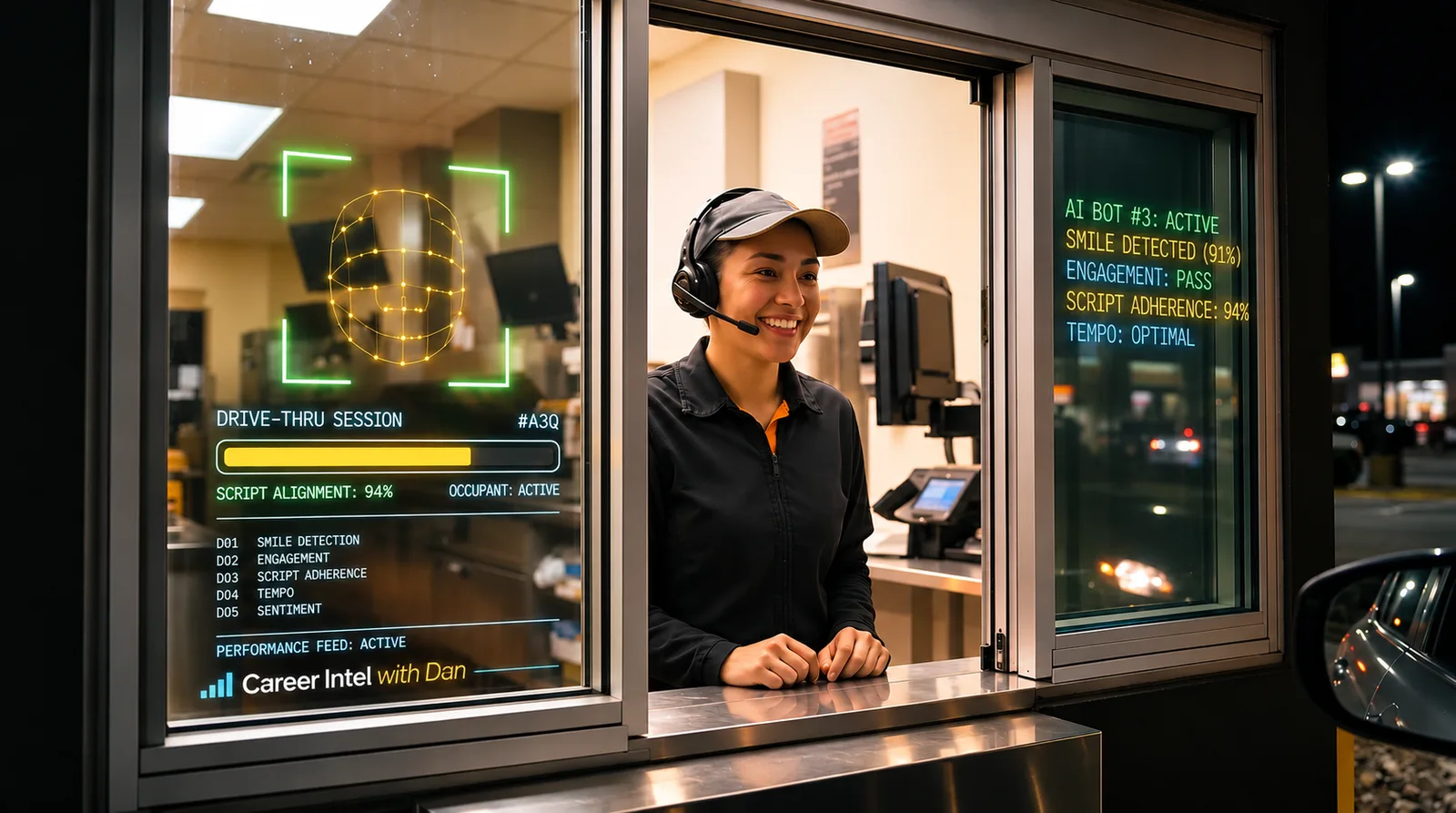
This week, AI showed up less as a pink slip and more as a scorekeeper. A Capital & Main investigation found fast-food drivers and drive-thru workers being rated, written up and cut from schedules by automated systems, and retail workers described a Black Friday spent clearing machine alerts and correcting customers' chatbots. Dallas Fed economists found that graduates of AI-exposed majors earned less in their first year out of school, and the Burning Glass Institute put the white-collar hiring shortfall at about 1.5 million jobs. Anthropic's interviews with its own enterprise customers found reduced hiring far more often than eliminated jobs, while a ZipRecruiter survey found more employers expecting AI to add headcount than cut it. SAP is reportedly weighing at least 10,000 cuts. Meanwhile, the broad labor market looked steadier: jobless claims fell to 189,000, consumers said jobs were easier to find, and Indeed postings rose 5.1% from a year earlier, though posted wages trailed prices. Closer to home, the Rochester metro posted a 3.2% unemployment rate for October. The common thread: the terms of work are changing faster than the headcount.
1. On the Front Line, AI Isn't Replacing Workers So Much as Scoring Them
A Capital & Main investigation, published by Fast Company on November 23, documents how fast-food companies are using AI to turn routine work into scores that can rank, discipline and schedule employees. Reporters interviewed more than a dozen workers, researchers and labor advocates. Drivosity, a GPS and AI driver-monitoring tool used by Domino's and Papa John's, scores each delivery trip from 0 to 100, and its HustleTime feature tracks how long drivers take to walk to their cars and hand off orders. Domino's drivers in North Texas said scores below 85 lead to write-ups and can lock them out of the system, and that the app penalizes actions like braking suddenly to avoid a collision. At Burger King locations in Niagara Falls, New York, workers said an OpenAI-powered assistant called "Patty" scored drive-thru conversations for friendliness and upselling against a 70% friendliness target, and that low scorers were cut from schedules. One worker said the system seemed to flag Black coworkers more often for "improper tone." Burger King said it had "never before heard" of penalties based on race or accent and that the features have since been disabled, without saying when. In Albany, a single restaurant called MashMore uses an HR chatbot that ranks employees with points tied to bonuses and promotions; its CEO said it would never be used to fire anyone. Domino's and Drivosity did not respond to requests for comment.
Retail workers described their own version over Black Friday week. A Walmart associate in southern Oregon told The Guardian she gets at least 10 or 15 automated safety alerts per shift and must upload a photo to clear each one, including alerts triggered by shadows or stickers. Walmart said the tools are meant to support associates, not replace their judgment. Separately, associates at Walmart and Home Depot described spending time correcting customers who arrive with chatbot-generated shopping lists, paint colors that don't exist and price demands, and United for Respect reported that 55% of retail workers it surveyed have seen staffing decreases attributed to automated technology. Workers and labor leaders are calling for human review before discipline and for protections negotiated into contracts.
- Domino's drivers in North Texas said a trip score below 85 out of 100 can mean a write-up or a system lockout.
- Burger King workers in Niagara Falls, New York, said low "Patty" friendliness scores cost them shifts; the company says those features are now off.
- California's new No Robo Bosses Act (SB 947), signed September 30, bars employers from relying solely on AI to fire or discipline workers; it covers California workers only.
These are worker accounts, not audited data, and the United for Respect figure comes without a published sample size, so treat the scale as unknown. What stands out is how different this AI story is from the one usually told. For hourly workers, AI is already on the job, not as a replacement but as a supervisor that sets the pace, flags behavior and feeds into schedules. A layoff gets counted; lost hours tied to a score usually don't. For job seekers in hourly roles, it's reasonable to ask in an interview which monitoring apps the job uses and how scores affect hours and discipline. For employers, a human review step before a score costs someone a shift is a basic safeguard against error-prone systems.
Impact: Immediate.
2. Two New Studies Put Numbers on the First Rung (Recurring Theme)
Federal Reserve Bank of Dallas economists Samuel Dodini, Tucker Smith and Yaling Xu released a working paper on November 24, "Degrees for GPTs," on how generative AI is changing the payoff of a college major. Graduates of majors with 10 percentage points higher exposure to AI automation had 10% lower first-year earnings after ChatGPT's release, driven by both lower employment rates and lower pay among those employed. Graduates of exposed majors whose coursework leaned toward less-exposed fields had smaller losses. Graduates of more-exposed majors were more likely to go to graduate school, mostly in the same field, and recent master's recipients in those fields also saw earnings declines.
A day earlier, the Burning Glass Institute released "Fewer Rungs, New Bridges," with RAISE US. It estimates that white-collar industries employ about 1.5 million fewer people than their earlier growth path implied. Among the third of occupations most exposed to AI, jobs where AI mainly helps workers grew by 1.4 million from 2023 to 2025, while jobs where AI can do much of the work shrank by 820,000, with clerical, administrative support and customer service hit hardest. Workers without a bachelor's degree hold 80% of the jobs AI is most likely to replace, and most established pathways out of those jobs lead to work that requires a degree. The report finds that AI could help a newcomer close nearly a third of the skills gap on those moves, and it recommends co-ops, apprenticeships and employer-designed projects to replace the experience entry-level jobs used to provide.
- A 10-point increase in a major's AI automation exposure was linked to 10% lower first-year earnings.
- A same-field master's degree did not offset the decline in the Dallas Fed data.
- Workers without bachelor's degrees hold 80% of the jobs AI is most likely to replace, per Burning Glass.
We've covered the entry-level squeeze often, most recently last week with ADP's payroll data. What's new here is pay: the Dallas Fed links AI exposure to measurable first-year earnings, not just hiring. Both studies show associations, and Burning Glass measures a gap from a trend line, so neither isolates AI from interest rates or the post-pandemic hiring reset. For students and recent graduates, the practical signal is that mixing in less-exposed coursework helped, while a same-field master's degree didn't. For workforce organizations, the 80% figure is a reminder that the people most exposed are often the ones without the degree the next rung requires.
Impact: Emerging.
3. Employers Describe AI and Hiring Two Different Ways
AI company Anthropic published qualitative research on November 23 based on 66 interviews at 58 U.S. companies that are its enterprise customers. People at about two-thirds of the companies reported reduced hiring because of AI; one interviewee put it as, "We may not be firing, but we're not hiring." Only two companies described AI fully eliminating a position and someone losing a job. Five described pushing out employees who would not adopt AI, 10 reported hiring more because of AI, and nine described cutting contracted work, including software development, customer service, legal counsel and back-office functions, much of which had already been offshored.
The same day, ZipRecruiter published its annual employer report, based on a September survey of more than 1,500 U.S. talent acquisition professionals and hiring managers. Thirty percent expect AI to increase headcount, up from 19% a year earlier, while 21% expect it to decrease headcount, down from 26%. Thirty-six percent plan to make entry-level workers a larger share of hires (up from 32%), and 11% a smaller share. The share planning pay raises fell to 59%, from 61% in 2025 and 79% in 2024.
- Anthropic: about two-thirds of interviewed companies reported reduced hiring; two reported a job eliminated by AI.
- Nine companies cut contracted work, a loss that never shows up in employee layoff counts.
- ZipRecruiter: 30% of hiring professionals expect AI to add headcount, vs. 21% expecting cuts.
Both sources have limits worth naming. Anthropic sells AI and interviewed a non-random group of its own customers, and ZipRecruiter's figures are plans, not hires. They also measure different things: what companies say has already happened versus what recruiters expect next year. Read together, they suggest the main channel so far is restraint, roles that aren't added and contracts that aren't renewed, which echoes Gartner's "jobs never posted" finding two weeks ago. For job seekers, that means fewer advertised openings even at growing companies. For employers and workforce boards, tracking backfills and contractor hours will show more than layoff counts.
Impact: Immediate.
4. SAP Reportedly Weighs at Least 10,000 Job Cuts in an AI Restructuring
Bloomberg reported on November 26 that SAP is considering cutting at least 10,000 positions, about 9% of its 113,076-person global workforce, as it restructures around AI, citing people familiar with the matter. The plan is not final. Reuters reported on November 27 that two sources described substantial planned cuts and that one said the works council had not yet been informed. SAP did not confirm a figure, saying it "continuously reviews its organization to ensure it remains aligned with its strategy and customer needs." The company's 2024 restructuring cost €3.1 billion, yet headcount still rose to 113,076 by September 2026, and CFO Dominik Asam recently said he would be "really surprised" if that slight growth didn't reverse.
- The reported figure is at least 10,000 roles, about 9% of SAP's workforce.
- SAP's 2024 restructuring cost €3.1 billion, and headcount rose afterward.
- Affected roles, locations and timing have not been disclosed.
This is a reported plan, not an announcement, and in Germany any cuts would go through negotiations with employee representatives, so the final number could change. It would be SAP's second large AI-framed restructuring in under three years at a profitable company, which raises the question we keep returning to: how much is AI doing the work, and how much is AI the stated reason for a cost reset? For U.S. workers in SAP implementation and support roles, it's worth watching for confirmed sites and roles before drawing conclusions.
Impact: Emerging.
5. The Numbers: Claims Drop to 189,000, Consumers See More Jobs, and Postings Rise
Initial unemployment claims fell 13,000 to a seasonally adjusted 189,000 for the week ending November 21, the Labor Department reported November 25; the prior week was revised to 202,000. The four-week average fell 1,500 to 196,000, and continuing claims fell 95,000 to 1,697,000 for the week ending November 14. Before seasonal adjustment, claims rose about 15,900, roughly half the increase the seasonal factors expected for the week before Thanksgiving.
The Conference Board's Consumer Confidence Index jumped 11.4 points to 103.3 in November. The share of consumers saying jobs are "plentiful" rose to 30.8% from 26.2%, and the share saying jobs are "hard to get" fell to 18.4% from 21.4%. Indeed's Job Postings Index reached 106.2 on November 13, up 2.3% from a month earlier and 5.1% from a year earlier. Posted wage growth was 2.6% in October, trailing the latest available CPI inflation reading of 3.7%. Engineering postings stood at 149 and health care at 134 relative to February 2020, while software development remained below its pre-pandemic level at 82, though up 23.4% over the year.
- Continuing claims fell 95,000 in one week, to 1,697,000.
- Consumers calling jobs "plentiful" rose to 30.8%, from 26.2% in October.
- Indeed: postings up 5.1% from a year ago; posted wages up 2.6% against 3.7% inflation.
On paper, this was a steadier week for the labor market than the AI headlines suggest. Two cautions: holiday seasonal adjustments are large, so one week of claims can swing, and Indeed's wage figure means many new offers aren't keeping up with prices. Software development postings are recovering but still sit well below 2020, which fits with stories 2 and 4. For job seekers, more openings in engineering and health care are real, but it's worth negotiating with inflation in mind. The November jobs report on December 4 will be a better test.
Impact: Immediate.
6. Closer to Home: Rochester-Area Unemployment Was 3.2% in October
The Rochester metro area's preliminary unemployment rate was 3.2% in October, the New York State Department of Labor reported November 24. County rates in the region ranged from 2.3% in Yates to 3.3% in Monroe, with Livingston at 3.0%, Orleans and Seneca at 2.9%, Ontario at 2.8%, Wayne at 2.7%, Genesee at 2.6% and Wyoming at 2.5%. Statewide, the unadjusted rate was 3.9%, and the seasonally adjusted rate dipped to 4.2% from 4.3% in September. The state skipped its usual year-over-year comparison because household survey data were not collected for October 2025 during the federal funding lapse.
- Monroe County had the region's highest rate, at 3.3%; Yates had the lowest, at 2.3%.
- Local rates are not seasonally adjusted, so month-to-month comparisons can mislead.
- No October-to-October comparison is available this year because of the 2025 data gap.
Read this alongside last week's figures showing the Rochester metro down about 2,000 private-sector jobs over the year. A low unemployment rate and a shrinking job count can coexist when fewer people are in the labor force or more commute elsewhere. For job seekers, the rate says little about whether employers in your field are hiring; openings by title and employer tell you more. For workforce providers, Monroe's rate sitting above its neighbors suggests the region's largest county is where most of the slack is.
Impact: Immediate.
7. Indian IT Workers' Union Asks for a National Policy on AI-Driven Layoffs
The Nascent Information Technology Employees Senate (NITES), an employee union, asked India's government on November 26 to create a policy framework protecting IT and IT-enabled services employees from job losses caused by AI and automation, and urged it to work with industry body Nasscom, IT companies and employee representatives. NITES called for mandatory disclosure of AI-linked job losses, including how many people are affected and how many jobs are directly replaced by technology; reasonable advance notice; fair severance; and efforts to upskill and redeploy employees before eliminating positions, with reskilling that is "meaningful and outcome-oriented." "Technological progress cannot become a justification for arbitrary job losses or the denial of employees' rights," NITES president Harpreet Singh Saluja said.
- NITES wants employers to disclose how many jobs are directly replaced by technology.
- The union asks that reskilling and redeployment come before termination, not after.
- The request goes to the government, with Nasscom and IT employers as proposed partners.
This is a demand, not a policy, and Nasscom and the government had not responded in the coverage we reviewed. It's notable because India's IT services sector does much of the outsourced technical and back-office work for U.S. companies, the same contracted work Anthropic's customers described cutting in story 3. It also mirrors a direction at least one U.S. state is taking: California's SB 951 will require employers to notify workers when AI is behind a mass layoff. Disclosure of whether a cut is AI-driven is becoming a labor issue on both sides of that relationship.
Impact: Emerging.
8. Nearly Half of U.S. Workers Report Using Generative AI. Health Care Lags on Everyday Tasks.
A CCIA Research Center report released November 23, based on Morning Consult surveys of more than 18,000 respondents since October 2024, found that 47% of U.S. workers use generative AI on the job, up from 31% in March 2025. Workers who use it estimated they save about six hours a week, which the report translates into roughly a 16% productivity gain for a full-time worker. CCIA is a tech industry association.
A JAMA Health Forum research letter published November 25 used the Census Bureau's March 2026 Household Trends and Outlook Pulse Survey of 6,277 workers. Before adjustment, 51.8% of health care workers reported any workplace AI use, compared with 57.5% of other workers. After adjusting for demographics, education, income and type of employer, health care workers were 9.4 percentage points less likely to report any use and 12.2 points less likely to report use in the past week. The biggest gaps were in general tasks such as generating ideas (22.2 points), administrative work (16.1) and summarizing (10.9). Medical care was the only task where health care workers reported more use.
- CCIA: 47% of workers report on-the-job generative AI use, up from 31% in March 2025.
- JAMA: health care workers trailed other workers by 16.1 points on AI use for administrative tasks.
- The JAMA survey had a 9.2% response rate, and the authors flag possible nonresponse bias.
The productivity figure is workers' own estimate of time saved, from a survey sponsored by an industry group, so treat it as an upper bound rather than a measurement. The health care finding is more useful for planning: the gap is largest in the paperwork and summarizing that eat up staff time, not in clinical work. For health care employers, administrative and support staff may be where AI training pays off first. For job seekers moving into health care support roles, comfort with these tools could stand out.
Impact: Emerging.
9. Mercedes-Benz Rolls Out AI Repair Assistance for Technicians, Starting in Alabama
Mercedes-Benz and Arena Physica announced on November 23 a global agreement to deploy Arena Physica's Atlas platform for electrical and electronic diagnostics and repair on Mercedes production lines, starting at the Tuscaloosa, Alabama, plant for the GLE and GLS, with pilots planned at other plants. Atlas points technicians to the most likely root cause, updates the repair plan as new measurements come in and records outcomes. The companies said that in initial testing, technicians at both new and experienced skill levels diagnosed and repaired issues 20% to 30% faster. They also cited faster onboarding of new technicians.
- Technicians still take the measurements and make the repairs; the AI recommends causes and next steps.
- The 20% to 30% speed gain comes from the companies' own testing, with no sample size disclosed.
- The announcement says nothing about staffing changes.
It's a company announcement, so the numbers are promotional until someone measures them independently. Still, it's a concrete example of AI augmenting skilled manual work rather than replacing it, the "augment" side of Burning Glass's split in story 2. For technicians and trainees, the skill that grows in value is checking a suggested diagnosis against what the meter says. For technical colleges and training providers, it's a workflow worth building into electrical troubleshooting courses.
Impact: Emerging.
10. The UAE Will Train More Than 80,000 Federal Employees in Agentic AI
The United Arab Emirates announced on November 27 a National Agentic AI Project to train more than 80,000 federal government employees, with nine technology partners: Etisalat, Inception42, Presight, ai71, Microsoft, Google Cloud, Oracle, Amazon Web Services and Accenture. The training workstream includes specialist courses, workshops and an AI-powered learning platform at several levels. It supports a government target of moving 50% of operations, procedures and services to agentic AI within two years.
- More than 80,000 federal employees are in scope.
- The goal is to shift half of government operations to agentic AI within two years.
- Nine companies are partners, including Microsoft, Google Cloud, Oracle and AWS.
The 50% figure is a target, not a result, and there's no outcome data yet. What's interesting is the pairing: an aggressive automation goal combined with training the whole workforce rather than starting with cuts. It's not a U.S. model and it's far from evaluated, but public workforce systems here can watch how training is tied to specific job categories, and whether the jobs themselves change.
Impact: Long-term.
11. Ubisoft Staff Say Pitches Must Justify Skipping Generative AI. Ubisoft Says It Isn't Required.
According to employees who spoke anonymously to the outlet Vertical Slice, teams pitching new projects at Ubisoft are expected to explain how generative AI will speed up production and to justify leaving it out. On November 26, Ubisoft responded: "We encourage our teams to explore where AI can be useful and bring value to their work. This doesn't mean that projects are required to use generative AI." It added that teams need to determine whether, and how, the technologies make sense for the game they want to make.
- The claim comes from anonymous employees; Ubisoft's statement is on the record.
- Ubisoft says AI use isn't required, without addressing whether skipping it must be justified.
- Creative and technical staff in game development are the most directly affected.
The statement and the claim aren't quite about the same thing: whether AI is mandatory in the final game versus whether skipping it has to be defended at the pitch stage. When the burden of proof shifts to the people who don't use AI, that's a workplace expectation, even if it's not a written rule.
Impact: Immediate.
12. Follow-up: The New Federal Contractor Test Takes Effect January 22
The Labor Department's independent contractor rule, covered here last week, was published in the Federal Register on November 23, setting its effective date at January 22, 2027. The rule weighs two core factors most heavily, control over the work and the worker's opportunity for profit or loss, under the Fair Labor Standards Act, the Family and Medical Leave Act and the Migrant and Seasonal Agricultural Worker Protection Act. One of its examples involves a delivery app, where short deadlines to accept jobs and penalties for turning them down weigh toward employee status.
- Effective date: January 22, 2027.
- Control and profit-or-loss opportunity are the two core factors.
- State and local classification standards still apply separately.
The new detail is the date. Connect it to story 1: app-based scoring and penalties are exactly the kind of control the rule examines. For gig workers and the advisors who help them, how an app assigns and polices work may matter more than what the contract calls you.
Impact: Emerging (effective Jan. 22, 2027).
Bottom line
For workers and job seekers, this week's evidence says AI is changing the terms of work faster than the number of jobs. Hourly workers are being scored and scheduled by systems they rarely see; new graduates in AI-exposed fields are starting at lower pay; and many companies are adding fewer roles rather than cutting existing ones. The broader market looked steadier this week, with more postings and fewer claims, but posted pay is trailing prices. Ask how performance is measured, and negotiate with inflation in mind.
For employers and workforce organizations, the signals worth tracking are the quiet ones: scores that affect hours, backfills that don't happen, contracts that end, and entry-level pay. Human review before automated discipline, clear disclosure when AI drives a cut, and training that reaches frontline and administrative staff are practical places to start.