
Career Intel with Dan 📊 | The Data Is In - And the Gap Is Widening


DEFINING PATTERN:
For the past two years, the AI-and-workforce story has been told in projections and predictions. This week, the data caught up. PwC's 2026 Global AI Jobs Barometer - built from over one billion job postings across 27 countries - gave us the clearest measurable picture yet of what is actually happening: the labor market is splitting in two, and the split is widening. Companies most able to use AI are seeing faster hiring, higher wages, and productivity gains that less-exposed firms simply cannot match. Workers with AI skills command a 62% wage premium. Workers without them are competing for roles that are shrinking or being redesigned around them.
What makes this week distinct is not one data point - it is the convergence of evidence across every level of the workforce. At the top, high earners in knowledge work face structural disruption to the tasks that justified their salaries. At the bottom, the entry-level on-ramp is narrowing: fewer standard junior roles, higher expectations for the ones that remain, and a career ladder that keeps moving up before new workers can reach the first rung. In the middle, employers are pairing AI tools with closer performance monitoring, tighter cost controls, and internal transformations that are proving harder to execute than the announcements suggested.
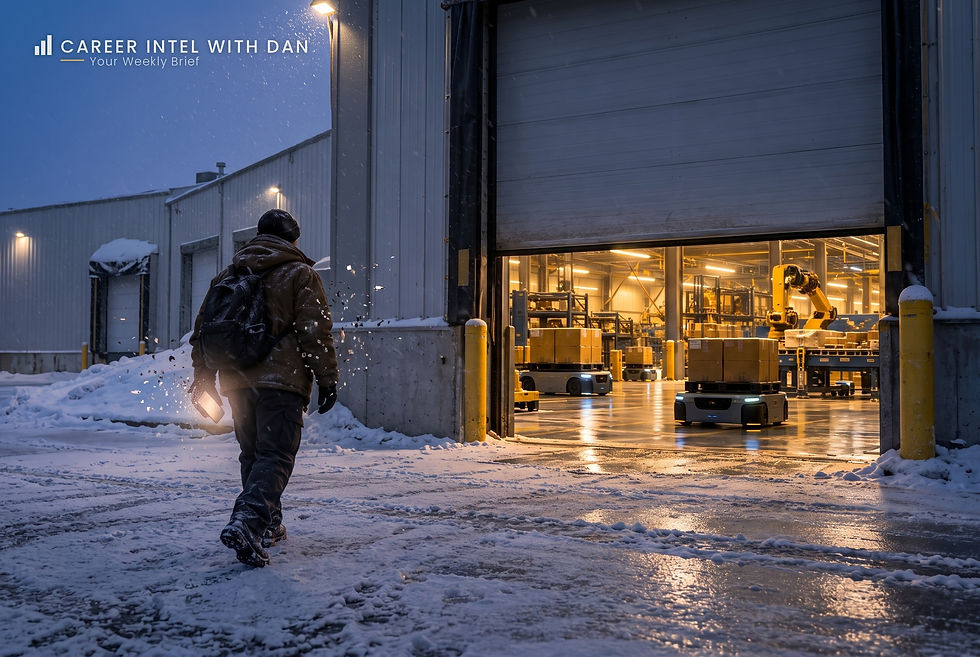
The one clear bright spot is also unexpected: the biggest workforce investments from AI companies this week were not in software - they were in electricians, welders, and construction workers. Google committed $50 million to train 300,000 trades workers for AI infrastructure. Meta's academy is already running. The jobs AI is creating most immediately are the ones needed to physically build it.
🔊 1. PwC's 2026 Global AI Jobs Barometer: The Two-Track Labor Market Is Now Measurable
PwC released its annual Barometer on June 15, analyzing over one billion job ads across 27 countries. The headline finding: a measurable split between AI-capable and AI-exposed companies. AI-exposed firms show headcount growth of 52% vs. 36% for less-exposed firms, wage growth of 24% vs. 17%, and the most AI-integrated superstar companies are achieving labor productivity gains of 163%. Jobs requiring specific AI skills are growing nearly 8x faster than the broader job market, with a 62% average wage premium for AI-skilled workers - up from 57% last year.
🔹 AI-exposed entry-level roles are now 7x more likely to require traditionally senior-level skills like leadership, judgment, and emotional intelligence.
🔹 Seniorized entry-level openings grew 35% since 2019, while standard entry-level roles fell 10%.
🔹 Democratized roles where AI absorbs routine tasks - like medical secretaries - are seeing stagnant growth and flat wages.
💡 This is the largest-scale data yet confirming what we have been watching: AI is bifurcating the labor market. Companies and workers who pair AI fluency with human judgment are pulling ahead. Everyone else is getting squeezed from below.
Impact: Immediate in hiring practices; emerging as a long-term structural shift.
🔊 2. AI Is Now the #1 Stated Reason for U.S. Layoffs - And the Named Companies Are Piling Up
Challenger, Gray & Christmas confirmed this week that AI is now the leading reason companies cite for cutting jobs, with tech seeing its steepest layoffs since early 2023. AI-linked cuts have hit 87,714 YTD - already surpassing all of 2025. Named this week: ServiceNow laid off hundreds as it expands AI use; Salesforce cut 86 roles across MuleSoft and Marketing Cloud. Separately, BLS data analyzed by Axios shows core white-collar sectors - professional services, financial activities, and information tech - have shed an average of 19,000 jobs per month since peaking in April 2023.
🔹 56% of all tracked layoff events in 2026 (150 of 267) explicitly cite AI, automation, or machine learning.
🔹 White-collar job losses are masked by strong headline employment because non-white-collar sectors added 3.7% more jobs over the same period.
🔹 Experts debate how much is genuine AI displacement vs. AI-washing of layoffs tied to pandemic overhiring - Sam Altman has acknowledged both dynamics occur and are hard to separate from outside a company.
💡 The debate over real vs. stated AI displacement is real and important. But even if some of it is framing, the framing matters - it shapes policy, public anxiety, and how displaced workers understand what happened to them.
Impact: Immediate and ongoing.
🔊 3. Forrester Projects Customer Service Workforce Could Drop 50% by 2030
Forrester released a new projection showing generative AI and conversational agents could cut the high-volume customer service workforce by up to 50% over the next four years. In their model, a contact center with 1,000 human reps could operate with just 40 by 2030. Gartner issued a counterpoint: half of organizations currently planning extreme AI headcount cuts will abandon those plans by 2027 due to operational friction.
🔹 Much of the contraction may happen through natural attrition rather than mass layoffs - contact center turnover already runs 30% to 100% annually.
🔹 Workers will be pushed toward relationship manager and subject matter expert roles handling complex escalations AI cannot resolve.
🔹 Gartner's counterpoint is worth noting - enterprise AI implementation consistently runs slower and harder than projected.
💡 The 50% figure is a projection, not a forecast. But even if the real number is 20% or 30%, that is still hundreds of thousands of jobs - and the timeline is short enough to matter for workforce planning right now.
Impact: Emerging; acceleration modeled for 2027-2030.
🔊 4. Google Commits $50M to Train 300,000 Workers for AI Infrastructure Trades
Google announced a $50 million initiative to train more than 300,000 U.S. workers for skilled trades tied to AI and energy infrastructure - electricians, plumbers, welders, and construction workers needed for data center expansion. This follows Meta's $115M America's Workforce Academy announced last week, targeting similar trade roles in data center regions.
🔹 The two largest AI companies are now both investing in blue-collar workforce pipelines tied to physical infrastructure.
🔹 AI's most immediate job creation is in construction, energy, and trades - not software.
🔹 This creates real near-term opportunities for workforce boards and training providers in regions with planned data center buildouts.
💡 Two weeks in a row, the biggest workforce investment news from AI companies is in the trades. The narrative that AI only creates tech jobs is not holding up.
Impact: Near-term for workforce programs; long-term for regional employment.
🔊 5. Lloyds Banking Group Hiring 300 AI Specialists - Finance Sector Joins the AI Buildout
Lloyds Banking Group announced it will hire 300 tech experts to expand agentic AI capabilities, building toward a 1,000-person AI team. Stated use cases include fraud prevention, customer finance insights, and HR document analysis. Lloyds says AI has already produced financial gains - while the same automation raises questions about future role redesign or reductions elsewhere in the organization.
🔹 This is a clear example of AI creating specialized roles at the same time it redesigns existing ones.
🔹 Financial services is now a leading sector for AI specialist hiring alongside tech.
🔹 The compliance and risk functions are both primary use cases and primary areas of concern.
💡 When a traditional bank is building a 1,000-person AI team, the AI hiring surge has officially crossed into mainstream industry. For job seekers with finance domain expertise and AI fluency, this is a real opportunity window.
Impact: Immediate for hiring; emerging for broader role redesign.
🔊 6. State Policy Wave: Connecticut Advances, California Builds Infrastructure, Colorado Retreats
Three significant state-level developments this week. Connecticut enacted a broad AI employment law requiring employers to provide written notice to applicants and employees whenever AI substantially influences hiring, promotion, discipline, or termination decisions - and requiring disclosure of AI involvement in mass layoff decisions. California's executive order continues moving through implementation: the Employment Development Department has 90 days to launch a public dashboard tracking AI's employment impact, and the Labor and Workforce Development Agency has 180 days to recommend WARN Act revisions. Colorado: a critical correction - Governor Polis signed SB 26-189 on May 14, delaying the Colorado AI Act to January 1, 2027, and the rewrite stripped the duty of care for algorithmic discrimination, dropped risk-management requirements, and cut reporting obligations.
🔹 Connecticut's law is the most immediate compliance obligation for multi-state employers using AI in employment decisions.
🔹 California's dashboard and WARN Act review mean real data infrastructure is being built - this becomes a template other states will watch.
🔹 Colorado's retreat is significant: the most prominent U.S. state AI employment guardrail was both delayed and substantially weakened.
💡 The state policy picture is uneven: Connecticut is moving forward, California is building, Colorado is pulling back. Employers need state-by-state awareness right now - there is no uniform federal floor.
Impact: Immediate in Connecticut; emerging in California; corrective for Colorado.
🔊 7. Jeff Bezos Says AI Will Cause Labor Shortages - Not Mass Unemployment
In remarks covered this week, Jeff Bezos argued AI's net labor-market effect could be worker shortages rather than mass replacement - a position in direct tension with Anthropic CEO Dario Amodei's recent warnings about significant entry-level job displacement. Both are prominent voices shaping employer and policymaker expectations.
🔹 The disagreement between Bezos and Amodei reflects genuine expert uncertainty, not a consensus view either way.
🔹 Bezos's argument rests on AI creating new demand and enabling new industries - Amodei's focuses on the structural disruption to existing roles before new ones form.
🔹 Public framing from high-profile tech leaders directly influences how employers make hiring decisions and how workers assess their own risk.
💡 When the two most prominent AI voices publicly disagree on whether AI causes unemployment or shortages, it is a signal that anyone claiming certainty about AI's net labor effect is overstating what the data currently supports.
Impact: Long-term and speculative; immediate in shaping public narrative.
🔊 8. TD Bank Deploys Workplace Monitoring Software for Hybrid Workers
TD Bank told some financial-crimes and risk-management employees it will use WorkiQ software to track time spent in browsers, internal chat, and meeting applications. TD says the goal is workflow management and productivity oversight, not recording conversations.
🔹 This fits the broader AI-era workplace pattern: companies pairing productivity analytics with tighter performance measurement.
🔹 For workers, it raises immediate privacy and trust concerns - especially for hybrid roles where monitoring feels more intrusive.
🔹 For employers, it signals a need for clearer governance around performance data and how AI-generated metrics are used in evaluations.
💡 Workplace monitoring is becoming an AI-adjacent workforce issue. As AI tools generate more data about how people work, organizations need explicit policies about what gets tracked, who sees it, and what it means for performance reviews.
Impact: Immediate for affected employees; emerging as a broader governance question.
🔊 9. Meta and OpenAI Both Signal AI Transformation Is Harder Than It Looks
Two enterprise AI stories this week pointed to internal friction. At Meta, Reuters reported that Emily Dalton Smith - head of product for Meta's AI for work transformation, including the Agent Transformation Accelerator aimed at automating employee tasks - is leaving. At OpenAI, the company introduced enhanced enterprise analytics and spending controls for ChatGPT Enterprise, giving organizations more visibility into usage and costs.
🔹 Meta's leadership turnover follows last week's admission that its AI restructuring created organizational strain - the pattern suggests large-scale internal AI transformation is consistently harder than anticipated.
🔹 OpenAI's spending controls reflect a shift from AI experimentation to managed enterprise deployment - organizations now need to track who uses AI, for what, and at what cost.
🔹 Both stories signal that enterprise AI is maturing from pilots to operations, and the operational challenges are real.
💡 AI transformation sounds strategic. The reality inside organizations is messy - leadership churn, governance gaps, and cost discipline. That is the part job seekers and workforce professionals rarely see in the headlines.
Impact: Immediate for enterprise users; emerging as a pattern across large employers.
🔊 10. U.S. Jobless Claims Edge Down but Labor Market Context Remains Important
Initial unemployment claims fell slightly to 226,000, remaining modestly elevated. Economists cited seasonal effects tied to school-year timing and described the labor market as broadly stable. Long-term unemployment and average job-search duration continue to trend up even as headline numbers hold.
🔹 AI-related disruption is unfolding inside a labor market that is not collapsing - but where re-entry is getting harder for displaced workers.
🔹 Hiring slowdowns and role redesigns are not always visible in claims data until well after the fact.
🔹 Workers affected by AI restructuring may face longer searches even when the overall market looks healthy.
💡 The macro numbers are stable. The individual experience for workers in AI-affected roles is not. Those are two different stories happening at the same time.
Impact: Immediate context for all workforce planning.
BOTTOM LINE:
The PwC data, the Challenger layoff numbers, the Forrester projections, and the state policy moves all point in the same direction: AI is not disrupting the labor market uniformly - it is disrupting it selectively, quickly, and unevenly. Connecticut moved. California is building. Colorado pulled back. There is no federal floor. The protections workers have right now depend entirely on which state they live in.
The workers who need the most support are often the least visible in the headline numbers. The roles most at risk are often the ones that look stable from the outside. And the skills that create separation are increasingly not technical - they are judgment, communication, and the ability to work alongside AI rather than be replaced by it.
The window to act is not coming. It is open right now.
Stay curious, stay current.
Dan Lopez | danscareercorner.com


Comments