
Career Intel with Dan 📊 | The Doors Are Moving

DEFINING PATTERN:
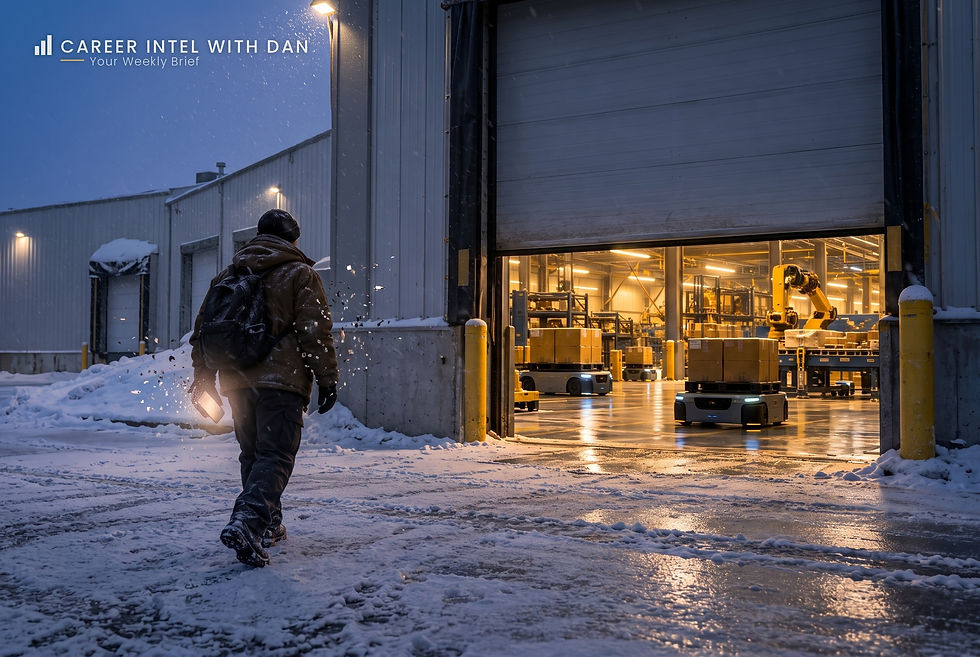
This week's developments point to a hiring system where the obstacles aren't where most people are looking. Employers' use of AI in recruiting has leveled off, yet job seekers' distrust keeps rising, and fake postings and ghosting are the more immediate day-to-day problem. Candidates and hiring managers don't share a definition of "AI-ready." Seasonal hiring, a classic first rung, is set to shrink again. And in the same week Verizon, Bank of America and the Labor Department put new money into training and apprenticeships, a WIOA provider with more than 50 years of service stopped taking new applicants. The doors into work are moving, and not everyone is being told where they went.
🔊 1. Employers' AI Use in Recruiting Leveled Off. Job Seeker Distrust Didn't.
iHire's 2026 State of Online Recruiting Report, released September 22, found that 24.2% of employers currently use AI in recruiting, down slightly from 25.9% in 2025 after steep climbs from 4.9% in 2023 and 14.7% in 2024. Among employers using it, the most common tasks are writing job ads (66.2%) and candidate communications (62.3%); 29.9% use it to screen applicants or resumes.
Job seekers are moving in the other direction. 44.3% view employers' AI use negatively, compared with 21.8% who view it positively. Their bigger frustrations sit elsewhere: 39.3% named fake, scam or "ghost" jobs as their top challenge, 41.2% encountered one in the past year, and 42.8% are frustrated by how hard it is to verify that a posting is legitimate. Employers report their own fraud problem, with 23.6% receiving at least one fraudulent applicant. Ghosting cuts both ways: 51.6% of employers cite unresponsive candidates, and 57.5% of candidates cite employers who never respond.
🔹 Employer AI adoption in recruiting slipped from 25.9% to 24.2%, the first dip in iHire's series after two years of rapid growth.
🔹 41.2% of job seekers ran into a fake or scam posting in the past year, which makes verifying employers a core job-search skill rather than an extra.
🔹 Only 29.9% of AI-using employers apply it to resume screening; most use it for ads and messages, so "beat the AI screener" advice targets a narrower slice of hiring than many job seekers assume.
💡 Hiring has a trust problem that runs in both directions, and AI is only one piece of it. Coaching people to verify employers and reach a human may pay off faster right now than coaching that only optimizes resumes for software. (Analysis; the survey measures self-reported experience, not audited postings.)
Impact: Immediate.
🔊 2. 93% of Job Seekers Say They're AI-Ready. Employers Are Using a Different Definition.
Two Harris Poll surveys for Express Employment Professionals, released together September 23, found that 93% of job seekers believe they have the AI skills employers want. But 41% of hiring managers say candidates need advanced or expert AI skills, while only 35% of job seekers think employers expect that level. Nine in ten hiring managers value at least basic AI skills, and 54% rate AI proficiency very important or essential.
What hiring managers described isn't tool familiarity. The AI capabilities they named most were data privacy and security awareness (45%), communicating AI findings clearly (45%) and understanding AI bias and fairness (37%). Yet only 19% called AI skills "absolutely essential," well behind dependability and work ethic (47% each), communication (45%) and technical skills (29%). The job seeker survey was fielded May 19 to June 8, 2026, among 1,000 U.S. adults who were employed and looking or unemployed and looking; the hiring manager survey was fielded May 13 to June 1, 2026, among 1,006 U.S. hiring decision-makers.
🔹 Self-assessment splits sharply by generation: 55% of millennials and 50% of Gen Z rate their own AI skills advanced or expert, versus 31% of Gen X and 12% of baby boomers.
🔹 Privacy awareness and explaining AI output (45% each) top employers' list, which points to judgment and communication rather than prompting tricks.
🔹 Only 19% of hiring managers call AI skills "absolutely essential," so AI fluency is being layered on top of basics like dependability, not replacing them.
💡 Job seekers should be ready to describe one real task they improved with AI, how they checked the output, and what they kept out of the tool. Employers could close much of this gap by defining AI expectations role by role instead of writing "AI proficiency" into every posting. (Employer-sponsored online survey of stated expectations, not observed hiring outcomes.)
Impact: Immediate.
🔊 3. Holiday Hiring Is Set to Shrink Again, Even With Shoppers Still Spending
Challenger, Gray & Christmas forecasts about 450,000 seasonal retail jobs in the fourth quarter of 2026, down from 461,500 in 2025, which was already the smallest holiday hiring season since 2008 and 15% below 2024. Seasonal transportation and warehousing hiring is expected to stay near 2025's 266,500. From 2019 through 2021, seasonal retail hiring topped 900,000 a year.
Weak demand isn't the obvious explanation: August retail sales rose 1.2% and back-to-school spending held up. Several employers that usually announce large seasonal numbers by now, including Amazon, Target, Kohl's and Bath & Body Works, had not, according to Challenger, which wrote that "AI, robotics, and automation continue to reshape the peak-season labor profile in warehousing." Separately, Amazon's raise for eligible full-time U.S. operations workers takes effect September 27, lifting the starting minimum to $20 an hour (announced September 16).
🔹 Teens, students and career changers who count on seasonal retail and warehouse work face fewer openings, likely filled earlier in the season.
🔹 Challenger says automation has "dulled" the traditional warehouse spike, one of the few places where automation is named alongside a measurable hiring decline.
🔹 Amazon's $20 floor for eligible full-time operations roles shows automation investment and higher frontline pay happening at the same company at the same time.
💡 Seasonal work has long served as both a first job and a bridge job. If that bridge keeps narrowing, workforce programs may need to connect people to seasonal openings earlier and build other paid first-experience options. (The 2026 figure is a forecast.)
Impact: Immediate.
🔊 4. Layoffs Stay Rare, Workers Stay Put and Postings Tick Up: New Data on a "Stuck" Market
Initial jobless claims fell to 197,000 for the week ending September 19, the Labor Department reported, with the four-week average dropping to 202,250. The same day, the Bureau of Labor Statistics reported that median employee tenure rose to 4.1 years in January 2026 from 3.9 years in January 2024, and the share of workers with a year or less on the job fell to 20.6% from 22.2%.
Indeed's Job Postings Index turned positive year over year, up 0.7% as of September 18, for the first time in nearly four years, and sits about 3% above its February 2020 baseline. New postings, though, were about 6% below that baseline. Together, the data describe a market where few people are losing jobs and fewer are changing them, which is different from a market where it's easy to get hired.
🔹 Short tenure isn't evenly spread: 25.0% of Black workers and 24.2% of Hispanic workers had a year or less with their employer, versus 19.8% of White and 17.3% of Asian workers.
🔹 Median tenure is 3.0 years for workers 25 to 34 and 9.6 years for those 55 to 64, so slower job movement lands very differently by career stage.
🔹 New postings still about 6% below the February 2020 baseline means today's searcher sees fewer fresh openings than the headline index suggests.
💡 Low layoffs are good news, but they aren't the same as open doors. For job seekers, this still favors targeted searches and networking over mass applications. For employers, retention may be improving partly because workers see few places to go; the BLS data don't say why tenure rose.
Impact: Immediate.
🔊 5. Verizon Puts $70 Million Behind Free AI Training, Delivered Through Community Partners
Verizon announced "Verizon AI Skills for America" on September 23, a $70 million commitment that combines $50 million in new funding with its existing $20 million Reskilling and Career Transition Fund for departing workers. The initiative offers a single online portal with AI training content from IBM, Google, Microsoft, Anthropic, Coursera and OpenAI at no cost, content Verizon values at more than $700 a year per person.
Delivery runs through community partners, including Goodwill Industries International, the Local Initiatives Support Corporation (LISC) and the National Association for Community College Entrepreneurship (NACCE), with hands-on coaching in select regional markets. Target groups are job seekers, early-career workers, displaced workers, educators and small businesses. The announcement did not include enrollment, completion, credential or placement targets. For context, this is not new: Verizon previously announced a reduction of more than 13,000 employees and said on its January 30, 2026 earnings call that the cuts were largely completed in the fourth quarter of 2025. Verizon tied its broader 2026 cost plan partly to "AI enablement," but has not attributed those job cuts to AI alone.
🔹 $20 million of the $70 million is an existing fund for Verizon's own departing workers, so the new money is $50 million.
🔹 Goodwill, LISC and NACCE handle local delivery, which puts community-based workforce organizations at the center of the rollout.
🔹 No outcome targets were published, so completions, credentials and job placements are the numbers to watch.
💡 The same company that reduced its workforce by 13,000 is now funding AI training for displaced workers nationally, which is worth noting without overstating the link. Free premium AI content lowers one barrier, but finishing a course and getting hired are separate problems. Workforce boards and American Job Centers in rollout markets have a reason to reach out early and connect participants to local hiring demand.
Impact: Emerging.
🔊 6. Bank of America Adds 1,000 Apprentices and $150 Million for Workforce Organizations
Bank of America said September 24 that it will hire 1,000 additional apprentices over the next two years, on top of the more than 800 it already hires each year. The paid apprenticeships run about 12 months and span consumer banking, technology, operations and other client-facing roles. The bank says roughly 40% of its current hires don't hold a bachelor's degree, and it cites a $50,000 minimum annual salary.
The bank also committed $150 million over five years to workforce development organizations, after investing about $40 million in 2025. CEO Brian Moynihan called it "one more way for us to help create a skilled American workforce for tomorrow," and Acting Secretary of Labor Keith Sonderling praised the investment.
🔹 1,000 added apprentices over two years comes on top of the 800-plus hired annually, a concrete degree-optional route into banking and tech.
🔹 The $150 million over five years goes to workforce organizations, not directly to placements, so local partners' capacity will shape who benefits.
🔹 Paid, roughly 12-month apprenticeships let career changers earn while they train instead of paying for a credential first.
💡 This is one of the clearer examples of skills-based hiring backed by actual job slots rather than a pledge. The slots are national and spread over two years, so the practical question for any region is whether local partners get a share.
Impact: Emerging.
🔊 7. DOL Awards $65 Million to Build Workforce Pell-Ready Community College Programs
The Labor Department's Employment and Training Administration awarded $65 million in the sixth round of Strengthening Community Colleges Training Grants to seven lead institutions and 102 consortium members in Colorado, Iowa, Mississippi, Missouri, Rhode Island, Tennessee and Texas. Individual awards range from about $6 million to $10.8 million.
The grants support short-term, industry-aligned programs designed to qualify for Workforce Pell Grants, in fields including AI infrastructure, advanced manufacturing, construction and skilled trades, nuclear energy, IT and shipbuilding. This round also emphasizes the state data systems needed to support Workforce Pell. New York was not among the funded lead states.
🔹 102 consortium members across seven states get funding to build or expand short programs that can qualify for Workforce Pell.
🔹 AI infrastructure sits beside skilled trades, nuclear energy and shipbuilding on the funded list, a signal of where DOL sees demand.
🔹 The data-system emphasis matters because Workforce Pell eligibility depends on programs meeting performance requirements, including job placement.
💡 This funds training capacity, not student aid or hiring. For workforce professionals in states that weren't funded, including New York, it previews what DOL is prioritizing in future rounds: short, employer-aligned programs with measurable outcomes.
Impact: Emerging.
🔊 8. A Tribal Workforce Provider Stops Taking New WIOA Applicants After Missing a New Federal Award
The Lumbee Regional Development Association (LRDA) in North Carolina announced September 24 that it is no longer accepting new WIOA applications from American Indian job seekers in Robeson, Scotland and Hoke counties, effective immediately, after it did not receive funding under a new Department of Labor grant award. LRDA has received direct DOL funding for employment and job training services since 1972.
Current participants will keep receiving services, and LRDA said it will continue serving American Indian clients in the western part of its former service area, with details to come. The organization stressed that it is not closing. The report does not explain why the award went elsewhere or who will serve new applicants in the three counties.
🔹 American Indian job seekers in Robeson, Scotland and Hoke counties lose a long-standing WIOA intake point, effective immediately.
🔹 Existing LRDA participants keep their services; only new applicants are turned away.
🔹 More than 50 years of continuous DOL-funded service ended on a single competitive award decision.
💡 The same week brought more than $250 million in new training and apprenticeship commitments from Verizon, Bank of America and DOL. A long-running provider losing WIOA intake is a reminder that new money and stable access are not the same thing, and that competitive funding can leave gaps that never make national news. (Single local source; the reason for the funding decision is unverified.)
Impact: Immediate.
🔊 9. New York Awards $42 Million for Youth Employment, Including $4.26 Million for the Finger Lakes
Governor Hochul announced $42 million for the 2026-27 Youth Employment Program, expected to provide paid work and training for at least 2,500 low-income and at-risk young people in communities covered by the state's Gun Involved Violence Elimination (GIVE) initiative outside New York City. The Finger Lakes allocation is $4,258,178.
Participants must be 14 to 20 years old with household income below 200% of the federal poverty level (about $54,640 for a family of three). The program year runs September 1, 2026 through June 30, 2027, pairing paid work with education and career exploration. Past participants have worked in schools, libraries, restaurants, camps and community organizations.
🔹 $4,258,178 comes to the Finger Lakes for paid youth work experience this school year.
🔹 Eligibility covers ages 14 to 20 below 200% of poverty, roughly $54,640 for a family of three.
🔹 The program year started September 1, so referrals from schools, county partners and youth-serving organizations matter now, not next summer.
💡 With seasonal retail hiring shrinking (see story 3), publicly funded work experience becomes a bigger share of the first-job pipeline for lower-income teens. The program is also framed as violence prevention through GIVE, which shapes where the money goes.
Impact: Immediate.
🔊 10. Who's Counting AI's Effect on Jobs? New York and Congress Move on Reporting
New York's AI Labor Information Act (S.8706-B/A.9581-B) passed both chambers of the legislature in June and still awaits action from Governor Hochul; in late August its sponsors publicly urged her to sign it. Covered businesses are companies doing business in New York that employ more than 50 people, as well as publicly traded companies. They would report annually to the state Department of Labor on AI-related hiring, displacement, reduced hours, positions left unfilled because of AI, and the nature of their AI use. In New York City, the City Council introduced a package on September 25 that includes Intro 161, requiring reports on AI's effects on the municipal workforce, including salaries, displacement and shifting responsibilities.
In Congress, Rep. Suzanne Bonamici introduced a human-centered AI framework on September 22 that would create an interagency council on AI in education and the workforce, require a national AI workforce strategy and state plans, track AI-disrupted jobs and displacement, fund community college, apprenticeship and reskilling grants, and seek EEOC guidance on discriminatory AI in hiring and evaluation. Rep. Jimmy Panetta joined the effort September 24. Separately, Sen. Mark Kelly introduced the Make AI Work for Americans Act on September 24, focused on AI literacy, training and mid-career workers. None of these is law yet.
🔹 If signed, New York's law would cover employers with more than 50 workers plus all publicly traded companies, and would track reduced hours and positions left unfilled because of AI, not just layoffs.
🔹 NYC's Intro 161 targets the city's own workforce, covering salary changes, displacement and shifting responsibilities.
🔹 The Bonamici framework pairs displacement reporting with grants for community colleges, apprenticeships and small employers, plus EEOC guidance on AI bias in hiring.
💡 Policymakers at every level are converging on the same gap: there is little reliable data on what AI is actually doing to jobs. Reporting mandates won't settle the debate, but they would replace anecdotes and press releases with something closer to evidence.
Impact: Long-term, with a New York decision possible any time before year-end.
🔊 11. The Workday AI Hiring Case Puts Vendor Responsibility in the Spotlight
New Reuters reporting on September 21 examined the federal lawsuit alleging that Workday's AI-driven applicant screening disproportionately rejected older, Black and disabled applicants. Lead plaintiff Derek Mobley, a Black man over 40 with disabilities, says he was rejected from more than 100 jobs through the platform. A federal judge previously allowed the case to proceed under a disparate-impact theory, which doesn't require proof of intentional discrimination.
Workday denies wrongdoing, saying its technology "does not make hiring decisions" and evaluates job-related qualifications rather than protected characteristics. A class-certification hearing is scheduled for March 2027. The central question is whether a software vendor, and not only the employer using it, can be held liable for discriminatory outcomes.
🔹 Older, Black and disabled applicants are the groups named in the allegations, which have not been proven.
🔹 The March 2027 class-certification hearing will decide whether the case proceeds on behalf of a much larger group of applicants.
🔹 Employers using vendor screening tools have reason to document testing and oversight now, while the liability question is still open.
💡 Read this alongside the iHire data in story 1: fewer employers than many assume use AI to screen resumes, but where it is used, the stakes for applicants and the legal exposure for employers are real.
Impact: Emerging.
🔊 12. IDB: AI Could Lift Latin America's Economy, but Wages Hinge on Whether Workers Can Move
The Inter-American Development Bank previewed findings on September 21 estimating that broad AI adoption could raise Latin American and Caribbean GDP by 5.1% over a decade, compared with 0.3% under limited adoption. Wages for workers able to move into expanding sectors could rise 2.3% to 5.3%, while wages for workers who can't could fall 13.5% to 20.9%.
The figures were released at a UN General Assembly-week gathering of regional heads of state and technology leaders. The full Development in the Americas report is due in November, so the complete methodology isn't public yet, and the projections apply to Latin American and Caribbean labor markets, not the United States.
🔹 The same adoption scenario produces either a wage gain of up to 5.3% or a loss of up to 20.9%, depending on whether workers can change occupations.
🔹 Limited adoption yields just 0.3% GDP growth over the decade, so the IDB frames slow adoption as a cost of its own.
🔹 The full methodology arrives with the November report, so these are preview figures.
💡 The headline "AI could cut wages 20%" misses the point. The IDB's scenarios make mobility (retraining, credential recognition and real transition pathways) the deciding variable. That lens fits the Spanish-speaking workers many U.S. workforce programs serve, even though the numbers themselves don't transfer. (Analysis.)
Impact: Long-term.
BOTTOM LINE:
For job seekers, the practical risks this week are less about an algorithm rejecting them and more about postings they can't verify, skill expectations nobody has spelled out, and fewer seasonal doors into a first job. The labor market is stable enough that layoffs remain rare, but tight enough that fresh openings still lag.
For employers and workforce organizations, the money is moving toward pathways: free AI training, paid apprenticeships, Workforce Pell-ready programs and youth work experience. The open question is who gets access. A WIOA door closing in North Carolina and New York's unsigned AI reporting bill are reminders that access and accountability don't happen automatically.
Stay curious, stay current
Dan Lopez | danscareercorner.com



Comments